Here’s the whole program in a sentence: if you want to score more, the single most important thing is the distribution of the shots you take. In a typical game about 70% of all shots are RED — and on average only 3% of them go in. “I can’t believe we lost, we had three times the shots.” Sure — but what kind of shots? Mostly red.
That’s why “Shoot the puck!” the moment you cross the blue line can actually hurt you. A shot at the first instance is usually a red shot — easy to save. A green shot goes in about 21.6% of the time versus 2.6% for a red shot — almost ten times more likely. Master this one idea and everything else in the program falls into place.
Understand the goalie: S.A.D.
To beat a goalie, you have to know what a good one is trying to do. Goalie coaches teach their goalies to be S.A.D.:
Square to the shooter — covering the most net possible.
Angle — lined up between the puck and the middle of the net.
Depth — out the right distance based on where the puck and players are.
A goalie who is S.A.D. is covering almost everything = Tough to score on!
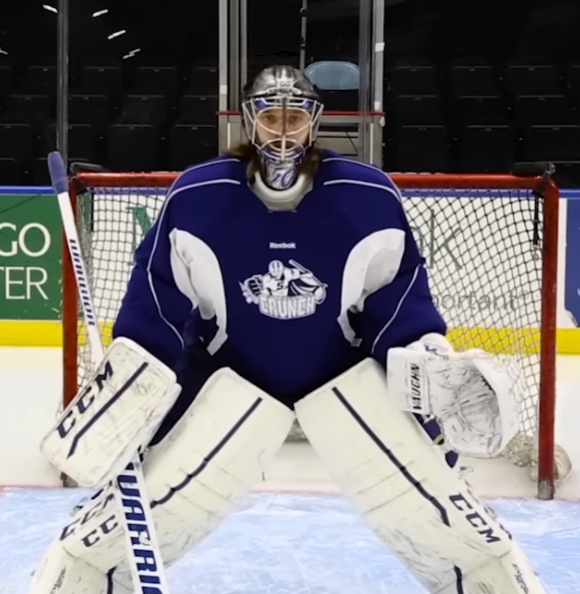
So your entire mission as a scorer is to make the goalie NOT S.A.D. — and the instant they’re not –> shoot.
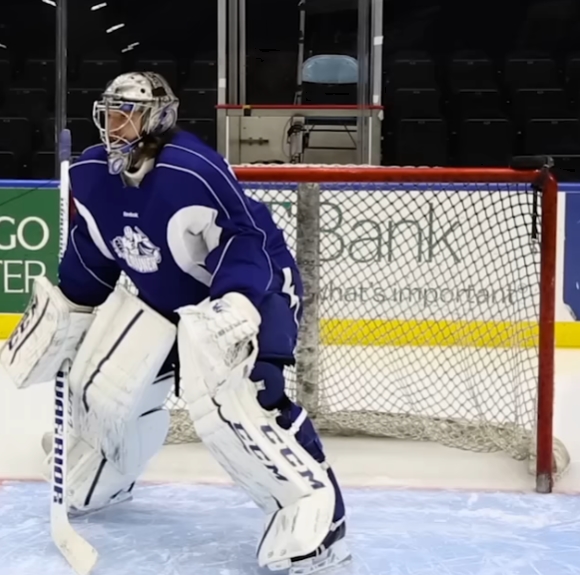
Create a “Great Green” shot
A green shot already takes away one of the goalie’s 3 S’s. A Great Green goes further: it’s when you make the goalie move TWICE before you shoot. Two quick passes before the shot make it almost impossible for the goalie to get Square, find their Angle, and set their Depth — so they’re never S.A.D. when the puck arrives.
Great Greens are hard to create in a tight 5-on-5 game, but they’re exactly what to hunt for on the power play or an odd-man rush, where you have the time and space to move the goalie more than once. (It’s no accident that most teams score more on power plays — because more green shots are created.)
How to beat a S.A.D. goalie?
How to beat a S.A.D. goalie
Most players will never face a perfectly S.A.D. pro goalie — but if you want to raise your odds against anyone, red shots are not the answer. Hunt for these, in order:
- Green shots — take away a SEE, a SECOND, or a SET.
- Yellow shots — get to the slot, the middle of the ice.
- Great Green shots — make the goalie move twice before you shoot.
- Chaos in front — teammates at the net or driving toward it, ready for tips, screens and rebounds.
When Passing Across the Slot Line:
PRO TIP: 1) Be a threat. When you carry the puck and show you are a real scoring threat, the defense has to respect you — and they forget about your teammates. Drive deep and sell the shot. Pull the goalie all the way to one post, and now they have the furthest possible distance to recover — which means a teammate on the far side has a wide-open net for a quick redirection.

2) Read the goalie (use misinformation)
“Take what the goalie gives you.” Make the goalie commit to either the pass or the shot, then do the other one. If the goalie cheats toward a teammate because they think you’ll pass, fire it into the space they just opened. If nothing’s there, fake the pass, see if they cheat, and then shoot. Read them first, then decide.
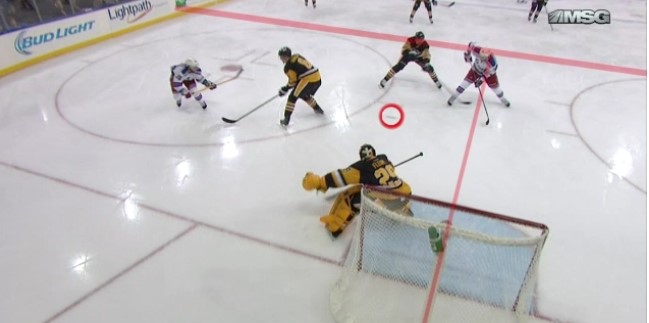
Try to make the goalie commit to either the PASS or the SHOT by using Misinformation…then act on the option that opens up.
Tip for the shooter:
1) Get to the soft spots. Off the puck, don’t just park at the net where you’re easy to cover. Make yourself available in a “soft spot” — open ice, often between the forwards and the D, outside the defender’s stick so the pass can’t be picked off.
2) Use timing: sometimes you draw defenders out by going high, then skate into the opening just as the passer is looking for you — catch it and shoot quick. A quick release from a soft spot is a green shot.
When having Possession across the “slot line”
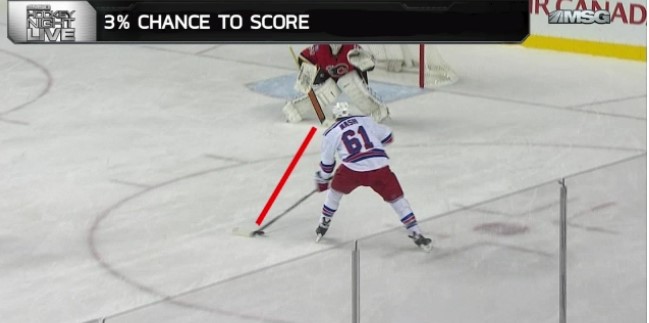
Any movement sideways of the puck forces the goaltender to open up holes in his stance.
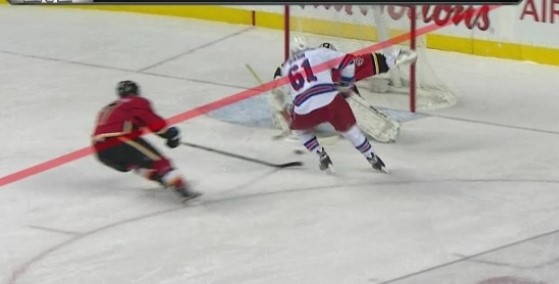
While you are carrying the puck sideways, use mis-information by faking a shot, if the goalie falls for it and drops like many goalies do, then carry it a couple of extra feet and give yourself a better angle to score.
How D can turn Red shots into Green:
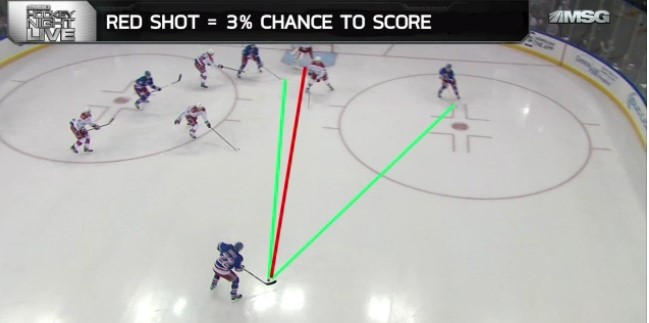
Here is an example where the NY Rangers defenseman has a few options:
1) Shoot the puck himself (Red shot = 3% chance of scoring)
2) Shoot for a deflection to the left (21 % scoring chance)
3) Shot-pass to the right for a 1-timer (16% scoring chance)
All 3 options could be a good scoring chance, but one little detail that can increase the chances for all three options is if the D-man moves the puck to his right, so the defender in front of the net screens his own goalie. Now he also created a Screen shot and the potential for a Green Rebound.
The bottom line
Two rules carry the whole mental model:
- Shoot more GREEN shots — and force the opponent to shoot RED.
- Don’t be too cute. A shot on net is better than no shot at all.
Track it: print the “Score More Goals” Self-Evaluation Sheet and chart your own shots for a few games. When you can see your green, yellow, and red mix on paper, the habit gets real — and the goals follow.
Fun Facts
• A typical game sees 25% GREEN shots, 5% Yellow Shots and 70% RED shots
• Average shot efficiency for a GREEN shot is 21.6% and 2.6% for a RED shot
• This corresponds to a save percentage SVS% of 78.4% and 97.4%
• A good offensive player shoots many GREEN shots
• A good defenseman prevents GREEN shots from the opponents
• A good goalkeeper saves most RED shots (and many GREEN shots).
• RED save percentage varies very little between different goalkeepers
• A typical distribution of power play and penalty kill is 40% GREEN shots / 60% RED shots and that is why you see more goals during a power play vs 5×5 play.