Welcome — How This Program Works
You can’t train what you can’t see.
This program makes Hockey IQ visible.
Welcome to the Hockey IQ Program. Before the first lesson, The above video is what this is, why it exists, and how we teach it — so you get the most out of every video that follows.
Look around online and you’ll find a lot of excellent skills coaches teaching skating, hands, and shooting — and today’s players are more skilled than ever. But the piece that actually separates players at the top is the hardest one to teach: the head — hockey sense, your Hockey IQ. A lot of people call it a buzzword that can’t be taught. We built this entire program because we believe the opposite.
Hockey’s 4 H’s.
A college coach used to say you need three H’s to play hockey: head, heart, and hands. Our founder got that — but he was also released by the Vancouver Canucks because he wasn’t an NHL-level skater. So the complete player really needs four H’s: head, heart, hands, and high-level skating.
Most players spend almost all their time on hands and skating. This program trains the one most people leave to chance — the head — because that’s the H that so often decides who reaches the top.
We teach decisions through Mental Models
Anything complex gets easier when you break it into smaller pieces. So we break Hockey IQ down into mental models. A mental model is simply an explanation of how something works — a thinking tool you use to understand a situation, make a decision, and solve a problem. Build up a library of hockey mental models and you stop guessing on the ice and start reading it.
What high-IQ players have in common
A coach in Sweden described high-Hockey-IQ players as sharing four things. This program is built to develop all four:
- Game understanding — they know what a good decision actually looks like.
- Ice awareness — they always know where teammates, opponents — even the referees — are.
- Pattern recognition — they’ve seen the game so many times that situations “click.”
- Problem solving — they combine the first three to solve the play in front of them.
We focus most on game understanding — what to strive for and why — then give you tips to read the ice and show you real video of the patterns that keep repeating, so you’ve already seen them before they happen in your game.
The learning cycle — where you’re headed
New skills move through four stages. The goal of this program is to move you out of Stage 1 and into Stages 2–3 — then reps take you the rest of the way:
- Unconscious incompetence — doing things wrong, and not knowing it.
- Conscious incompetence — still doing it wrong, but now you’re aware of it.
- Conscious competence — doing it right, but you still have to think about it.
- Unconscious competence — doing it right without thinking — the “Sidney Crosby level.”
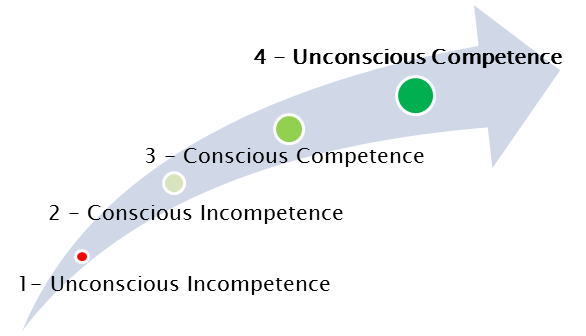
Crosby doesn’t skate around planning his next move — he’s done it so many times that the right play just comes out. You get there the same way: build the understanding here, then go play, make mistakes, learn, rinse and repeat.
Start by creating a goal
Before Lesson 1, do one thing: complete the “Creating a Goal” worksheet (print it from this lesson). A goal that comes from within is what keeps you moving forward when training gets hard or you hit a setback — because when you truly want something, you work far harder for it than you ever would for someone else’s goal. Make it vivid enough to see, hear, and feel, and revisit it often.
The bottom line
Hockey IQ is a thinking tool, and like any tool it sharpens with use. The more situations you watch, face, and analyze, the clearer and faster your decisions become. That’s the whole path — and we’re glad to be on it with you. Welcome aboard, and let’s raise your Hockey IQ.